Overview
Curated abstract when available.
This paper introduces a variational formulation of natural selection, paying special atten-
tion to the nature of ‘things’ and the way that different ‘kinds’ of ‘things’ are individuated from —
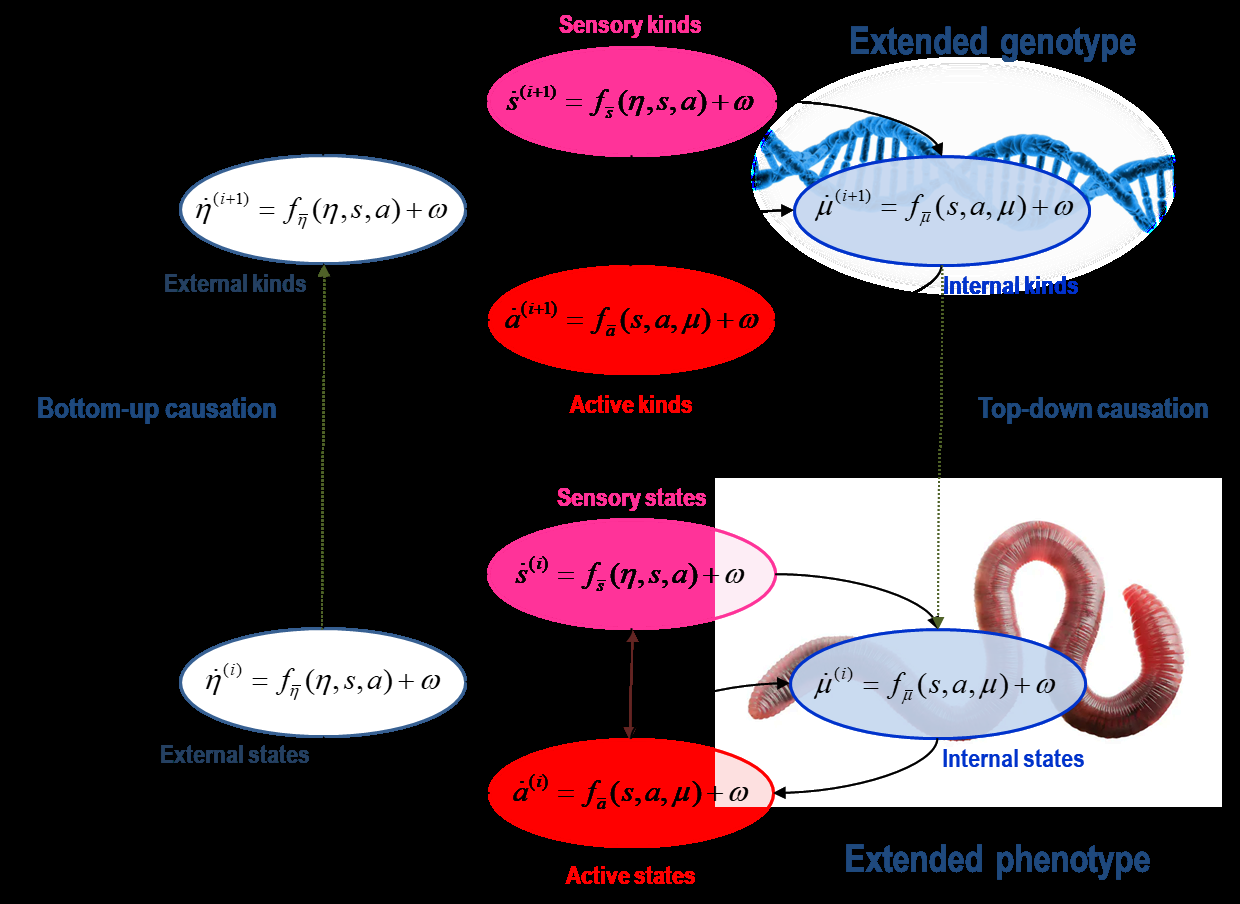
and influence—each other. We use the Bayesian mechanics of particular partitions to understand
how slow phylogenetic processes constrain —and are constrained by —fast, phenotypic processes.
The main result is a formulation of adaptive fitness as a path integral of phenotypic fitness. Paths of
least action, at the phenotypic and phylogenetic scales, can then be read as inference and learning
processes, respectively. In this view, a phenotype actively infers the state of its econiche under a
generative model, whose parameters are learned via natural (Bayesian model) selection. The ensu-
ing variational synthesis features some unexpected aspects. Perhaps the most notable is that it is not
possible to describe or model a population of conspecifics per se. Rather, it is necessary to consider
populations of distinct natural kinds that influence each other. This paper is limited to a description
of the mathematical apparatus and accompanying ideas. Subsequent work will use these methods
for simulations and numerical analyses —and identify points of contact with related mathematical
formulations of evolution.
Overview source: Curated paper metadata.
Artifacts
Tracked documentation and PDFs served directly from this folder.
README AGENTS SKILL Metadata Extracted text Citation metadata
- 2023_VariationalSynthesis.pdf 1,488,327 bytes · extracted-text source
Extracted Images (7) — GitHub +1 more