Corrected source review
The current retained analytical epoch has an explicit membership audit with exact cross-artifact member, modality and byte bindings. Historical analytical, diagnostic and current exporter identities are reported separately. The older coverage/embedding discrepancy remains unrecovered; matching the retained run does not establish new inference, whole-oeuvre coverage or a revised deposited edition.
This review is bound to the linked source commit. Current summaries, downloads and extracted text retain their own source provenance; these corrections do not recover missing historical evidence or constitute a newly deposited publication edition.
Read the pinned source correction (reviewed 2026-11-05).
Overview
Curated abstract when available.
William Blake's works survive across editions, copy records, image archives, museum catalogues, transcriptions, and finding aids. Computational coverage is difficult to assess without explicit units, source authority, and evidence boundaries. We present *blake*, a 7-phase pipeline that connects a 104-entry work-level target ledger with retained source records, local analysis, provenance, recoverability checks, and generated publication artifacts.
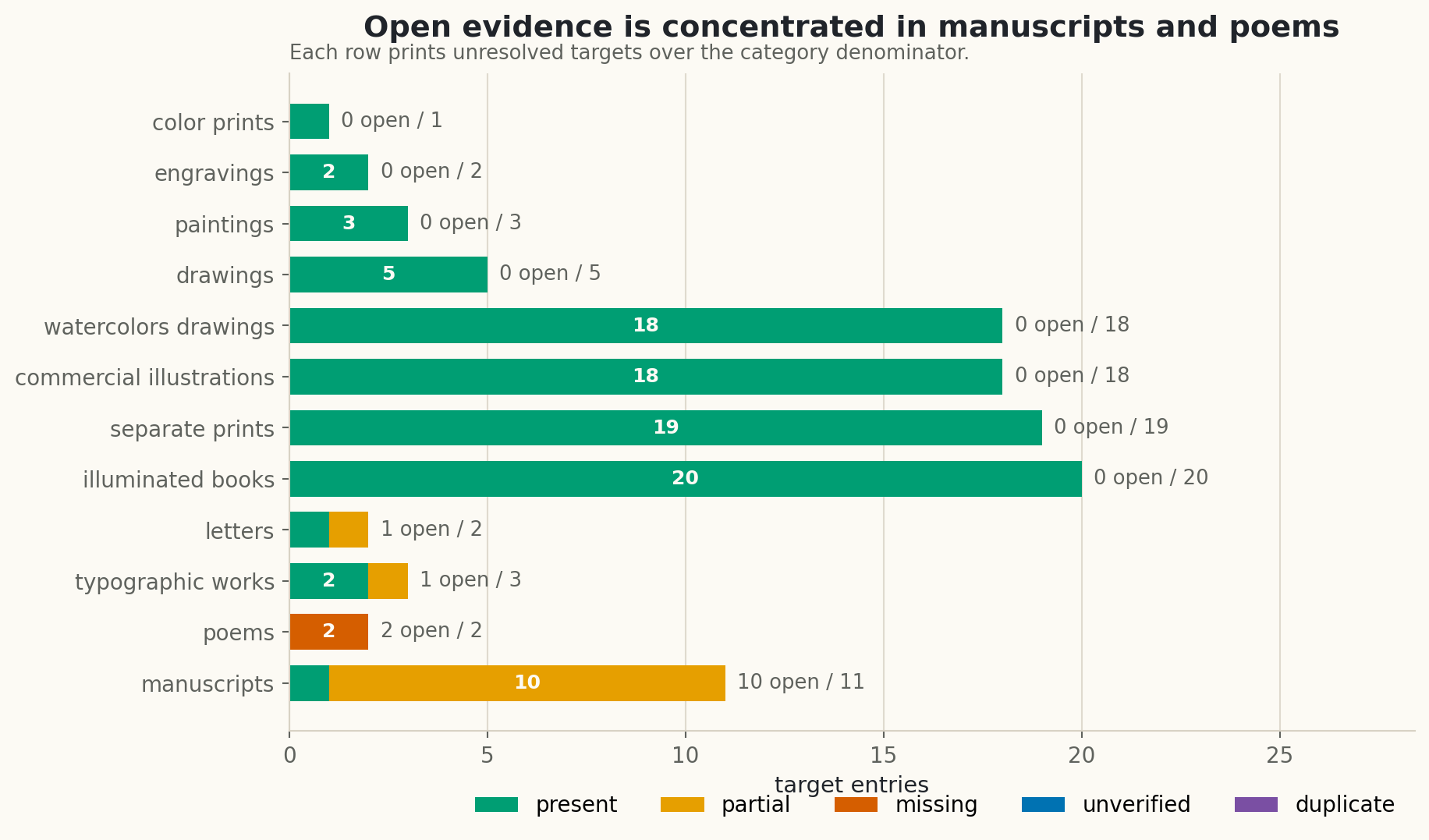
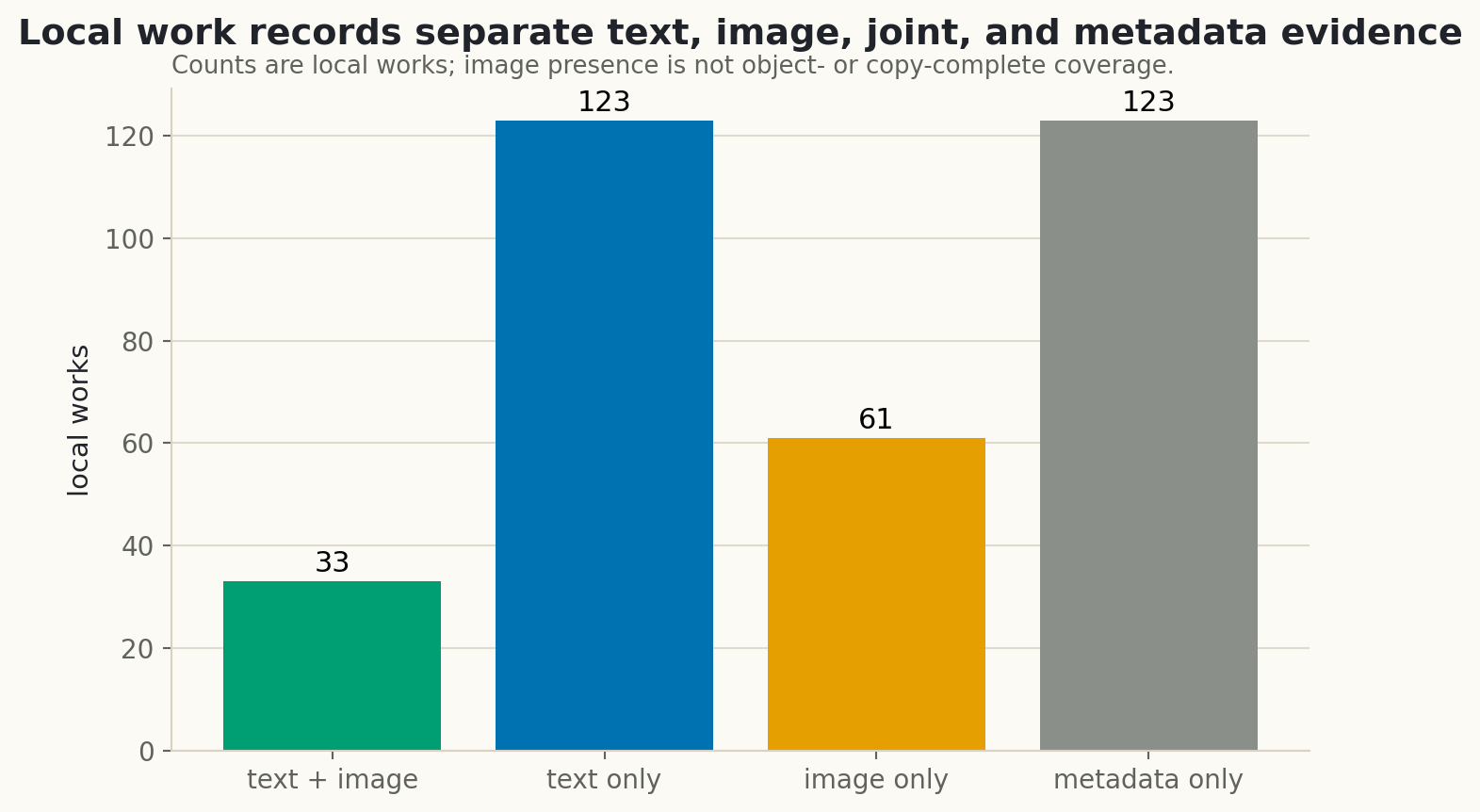
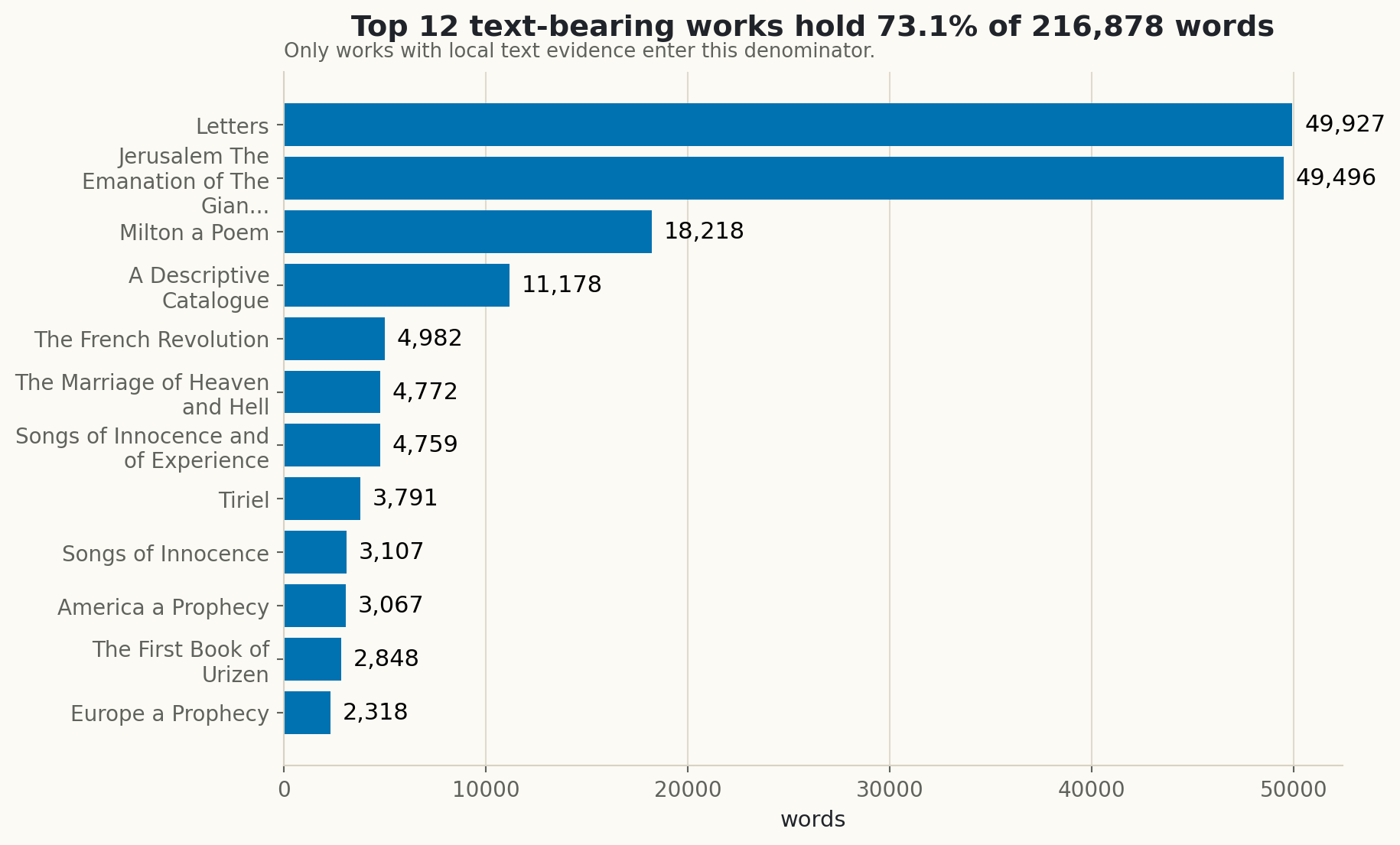
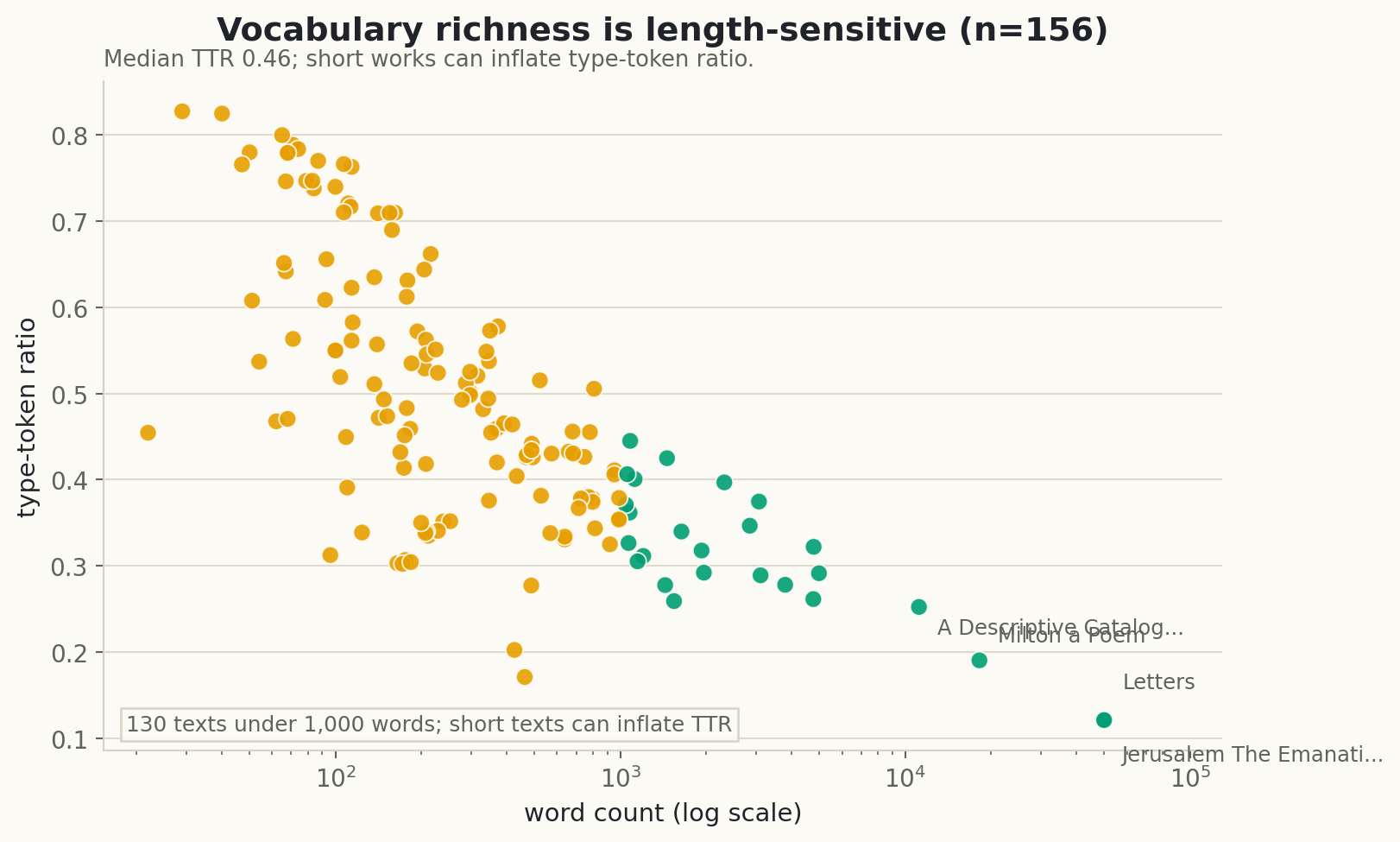
The saved offline run analyzes 727 local source/copy records. Its 6109 image associations reference 5975 distinct files. It represents 69 ledger targets (66.3%) and fully satisfies the declared evidence profile for 45 targets (43.3%). The text-bearing subset has 540 records and 682407 tokenizer-defined words. These exploratory text results include retained transcriptions with unverified authorship; they are not a Blake-authored language census. The top-level analysis ledger records 727/727 records analyzed and 0 top-level errors. Nested sub-analysis limitations are counted separately.
Local recovery preserves 8481 inventoried files and 5975/6003 discovered image identifiers, leaving 28 unresolved. Checksums and a corruption-detection restore drill establish recoverability of the captured inventory, not completeness of Blake's oeuvre. Quantitative prose, tables, and figures derive from saved artifacts. Public releases contain project-authored software, manuscript sources, aggregate evidence, and checksums; provider texts, XML, images, private indexes, backups, and source-image mosaics remain local. The contribution is an auditable corpus-governance and preservation method with explicit scholarly and distribution limits.
The implementation separates corpus custody from application policy. Portable source snapshots and explicit schema conversion preserve source identities and roles, while distinct retrieval profiles expose normalized-token, literal-casefold and regex contracts. Shared counting, hierarchy and evidence-admission methods support application papers without embedding their vocabularies or interpretations. Current source-derived diagrams identify those interfaces separately from the historical analytical producer.
This deposit pairs the 94-page manuscript edition 0.5.0 with Blake software release 0.7.0. Generic half-open interval methods preserve occupied support, multiplicity and overlapping record pairs while applications retain source grouping and domain judgments. Entomology and Federalism are independent applications, linked as related research objects rather than runtime dependencies.
Overview source: Curated paper metadata.
Artifacts
Tracked documentation, preserved local archives, and the selected Zenodo edition.
README AGENTS SKILL Metadata Extracted text Citation metadata
- Blake.pdf Zenodo version 0.5.0 · 11,762,801 bytes
- blake_working_paper.pdf 11,255,591 bytes · preserved historical archive
- Current PDF version 0.5.0 is hosted at Zenodo. Local PDFs remain preserved historical archives. Extracted text retains its own source provenance; a matching filename does not establish edition identity.
Historical figures (edition 0.1.0) (19) — GitHub +13 more Source PDF: blake_working_paper.pdf; extraction: full_text_v0.1.md.