Overview
Curated abstract when available.
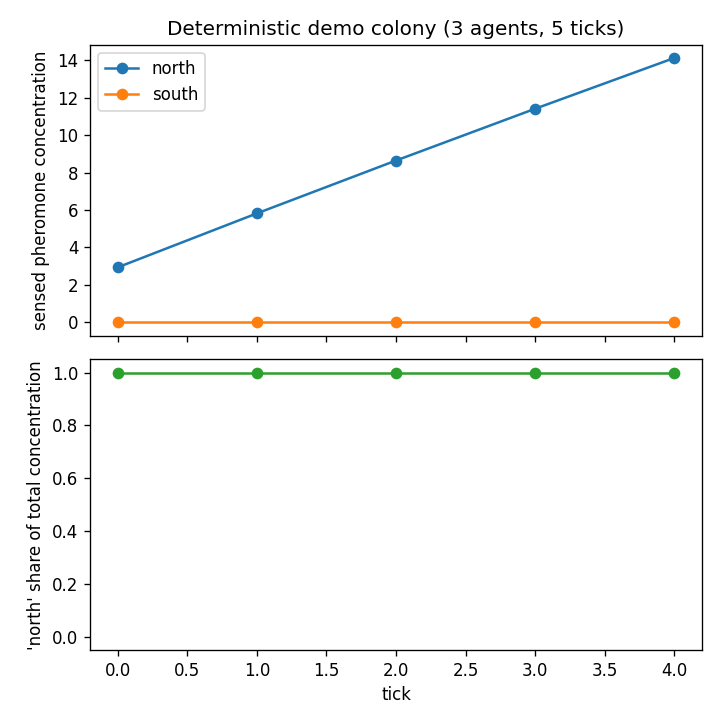
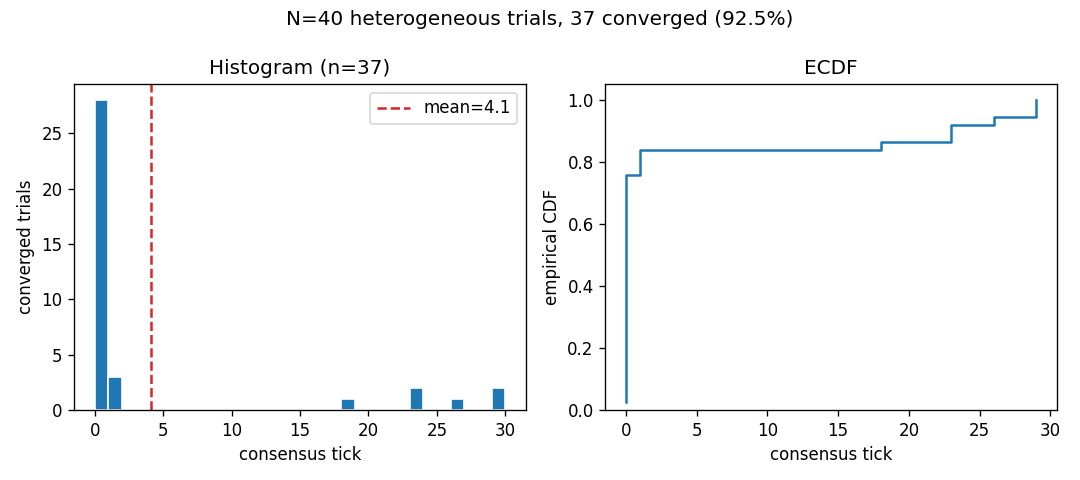
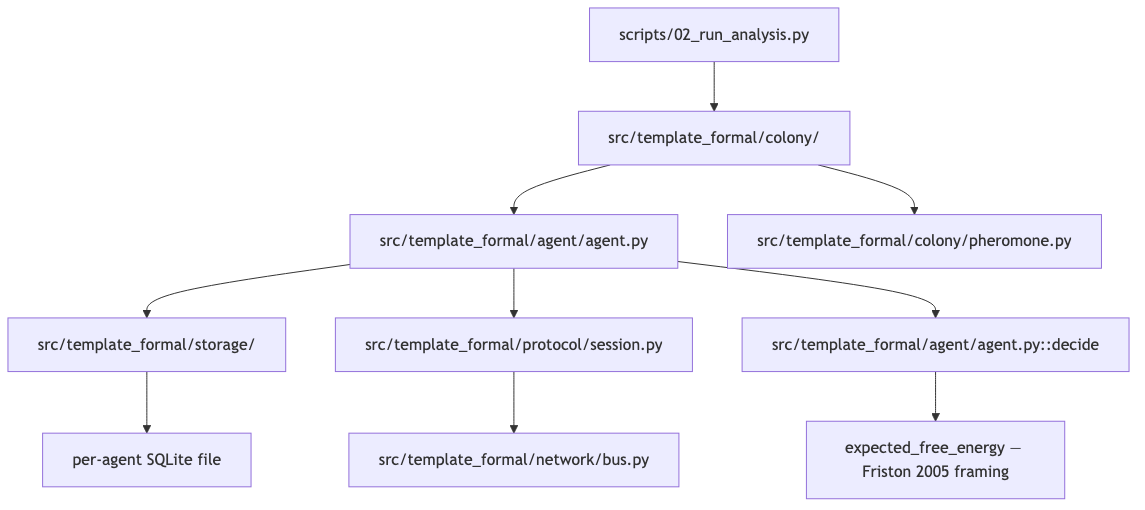
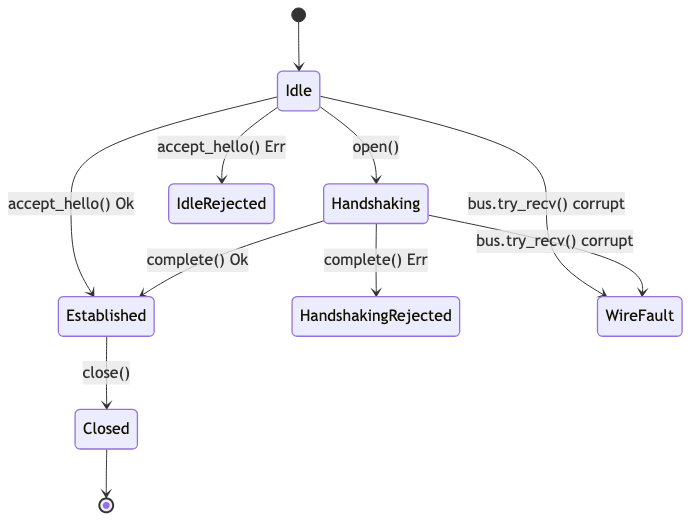
This paper presents a strongly-typed, decentralized multiagent simulation — an ant-robot colony — as the computational exemplar of the Research Project Template (https://github.com/docxology/template). Each colony member is an Agent that owns exactly one real, on-disk SQLite database and one in-process, fault-injectable protocol endpoint; no agent ever touches another agent's storage or network state. The implementation lives under projects/templates/template_formal/src/template_formal/; the demo pipeline is orchestrated by scripts/02_run_analysis.py. The paper's central claim is methodological, not a typing-features showcase: static typing's honest value in Python is edit-time/CI-time error prevention on structurally representable invariants, and nothing more. Nominal identifiers (AgentId, MessageId, TxnId as distinct NewType wrappers), a tagged-union Result[T, E] ADT with match-exhaustiveness, and a session-typed protocol state machine (IdleSession → HandshakingSession → EstablishedSession → ClosedSession) each make an illegal program a type error, verified by a real mypy --strict subprocess run against six known-bad negative-control fixtures plus three known-good positive-control fixtures (tests/mypy_fixtures/). Where the type system cannot help — reusing a consumed transaction handle, reusing a consumed protocol-phase instance, or receiving malformed bytes off an untyped network boundary — the implementation runtime-guards instead, and the manuscript says so explicitly rather than eliding the distinction. We also frame, without over-claiming, two additional lenses: the per-agent storage schema as a functor $\mathrm{Schema} \to \mathbf{Set}$ in the sense of @fong2018seven, and each agent's per-tick decision as an approximate minimizer of a closed-form expected-free-energy quantity in the spirit of @friston2005theory, bridged to collective organization via the Memory Evolutive Systems framework of . Both framings are declared as design lenses, not machine-checked mathematical results — the paper is explicit about which of its claims are proofs and which are analogies. Contributions are architectural, epistemic, and empirical. Architecturally: a zero-mock test suite (tests/) covering ADT exhaustiveness, affine-handle reuse, session-type phase transitions, seeded fault injection over a real in-process bus, and a three-agent colony integration test exhibiting a real stigmergic positive-feedback mechanism (deliberately not overclaimed as "emergence" — see @sec:results-discussion). Epistemically: an explicit "What mypy --strict proves vs. what is a runtime discipline" section (@sec:honesty-line) that pins every strong claim to the ISC (Ideal-State Criterion) number of its paired negative-control test, so the claim-to-evidence mapping is auditable rather than asserted. Empirically: eight pre-registered analyses grouped across three experiment families, falsifiable experiments (@sec:results-discussion) — a decay-rate sweep revealing a real, non-monotonic threshold effect (near-zero convergence below decay $\approx 0.35$, a $100\%$ plateau at moderate decay, and a measurable decline at total evaporation); a random-choice null-model comparison showing the real mechanism's Wilson-bounded convergence rate ($93.3\%$) does not overlap a chance baseline's ($0.67\%$); and a heterogeneity-magnitude sweep showing convergence rate decreases strictly monotonically as agent preferences spread wider — each stated with its falsification criterion before its real, seeded result, using genuinely new stdlib-only infrastructure (colony/nullmodel.py, colony/sweep.py) rather than one-off scripts. Keywords: strongly typed programming, session types, algebraic data types, category theory, Active Inference, multiagent systems, affine types, illegal state unrepresentable.
Overview source: Curated paper metadata.
Artifacts
Tracked documentation and PDFs served directly from this folder.
README AGENTS SKILL Metadata Extracted text Citation metadata
- Friedman_2026_Illegal_5bda439c.pdf 551,781 bytes · extracted-text source