Overview
Curated abstract when available.
The AlphaFund whitepaper reframes recursive self-improvement (RSI) as a portfolio
optimization problem: a corporation recursively improves when realized economic
gains finance the next cycle of better prediction and deployment, and the firm's
standing is summarized by t-RSI, a standardized gap between alpha-creation and
alpha-decay rates. AlphaCOGANT observes that this construction is, term for
term, an Active Inference agent — and makes the correspondence executable.
We render AlphaFund's Economic World Model (EWM) as a generative model written
in Generalized Notation Notation (GNN), produced by the COGANT
codebase-to-GNN translation pattern. The firm's five capital channels —
Investments, Sensors, Actuators, Parameters, and R&D — become the hidden-state
factors of a partially-observed model; capital allocation becomes the control
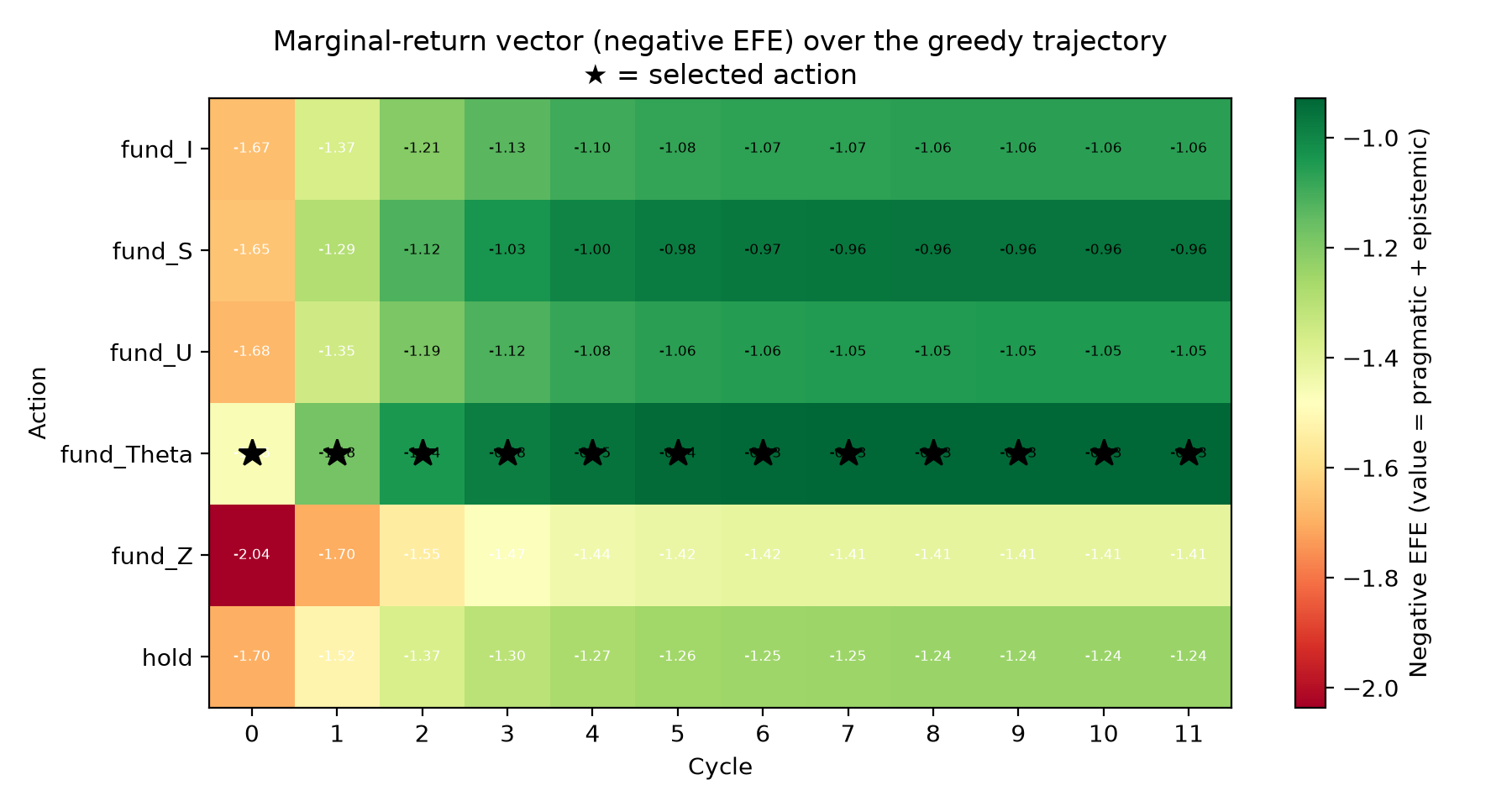
vector; and the portfolio optimizer's marginal-return objective becomes
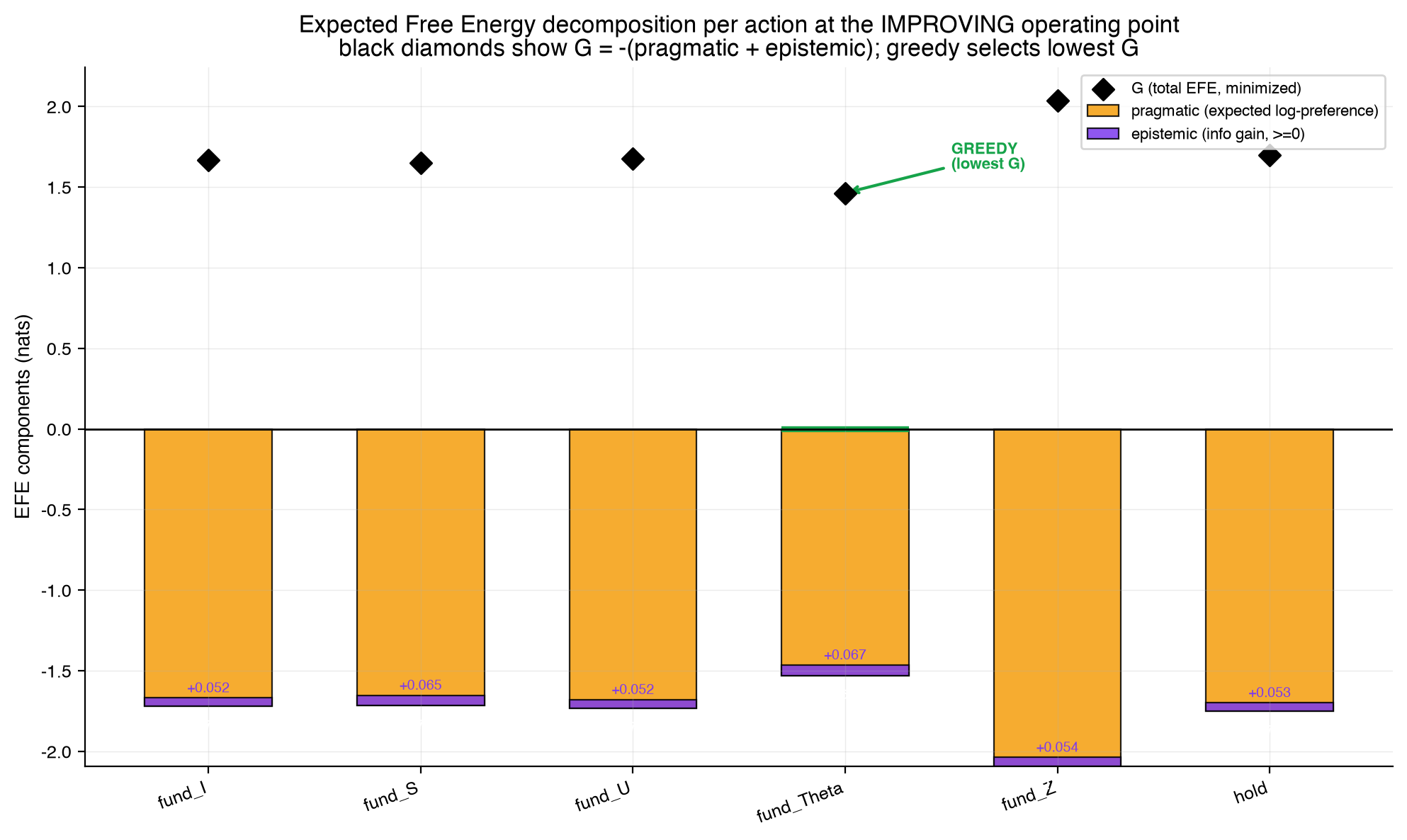
Expected Free Energy (EFE) minimization. The EFE decomposition supplies a
principled reading of AlphaFund's own categories: its pragmatic value is
expected log-equity growth (the alpha-creation rate, read off the broker ledger),
and its epistemic value is the information gain about the EWM that Sensors and
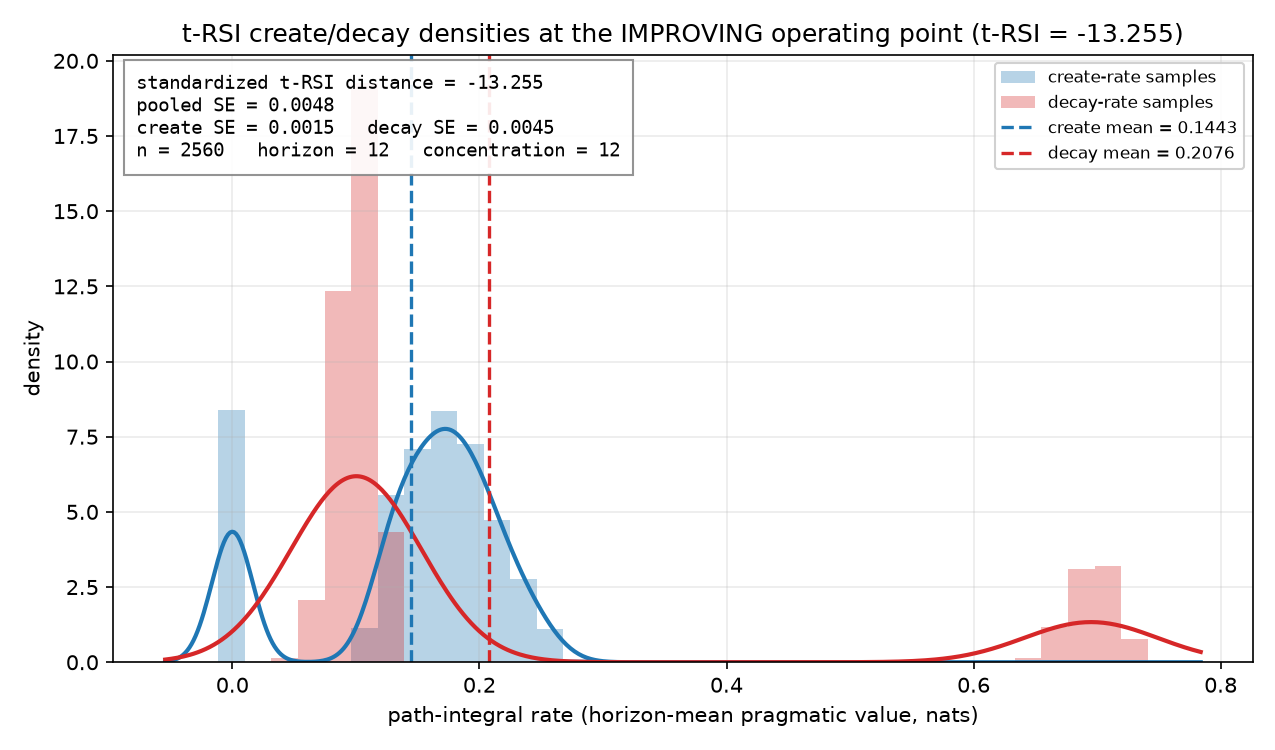
R&D purchase (the data-scaling and forecast-sharpening laws). t-RSI is recovered
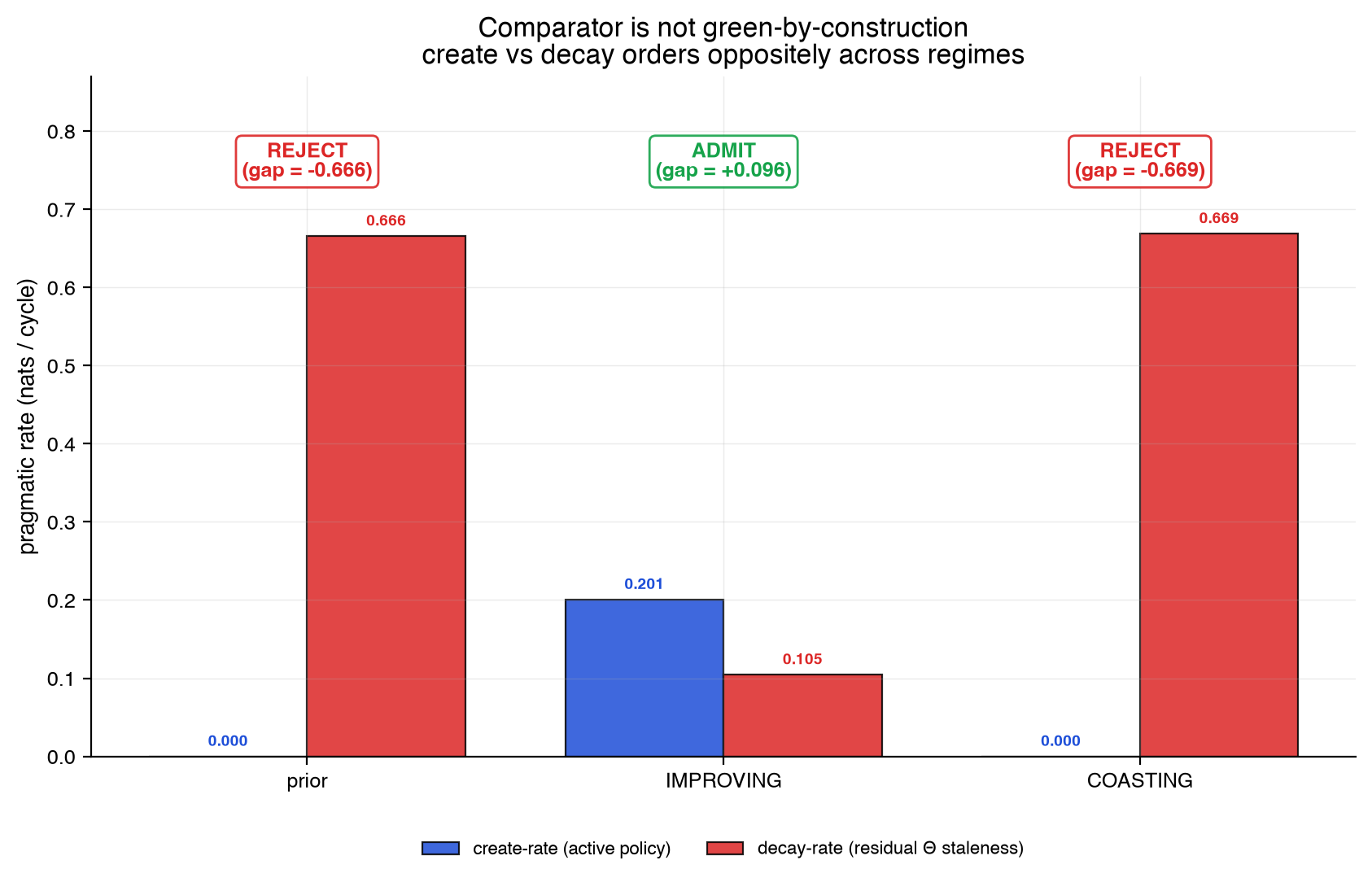
as the standardized distance between the create-rate and decay-rate posteriors —
the thresholded EFE-improvement certificate that admits a self-improvement commit
only when creation confidently exceeds decay.
We give the technical and computational realization: a GNN model file for the
five-channel firm, a tested NumPy Active Inference engine that performs state
inference, computes the epistemic/pragmatic EFE split and the marginal-return
vector, and evaluates the t-RSI certificate. We argue that GNN-via-COGANT brings
two things AlphaFund's program needs and Active Inference already enforces:
filtration integrity (the model may condition only on information available
at decision time — the same "no-peeking" discipline that separates an EWM from a
language model) and auditable capital allocation (every admissible funding
move has a negative-EFE score under a single, legible objective). This is not
financial advice; it is a demonstration that this reduced
recursive-corporate-self-improvement model has a direct Active Inference
representation supported by source-owning methods and artifact checks .
---
Associated artifacts
GitHub release: v1.0.1 (https://github.com/docxology/alphacogant/releases/tag/v1.0.1)
DOI: https://doi.org/10.5281/zenodo.20976824
Zenodo: https://zenodo.org/records/20976824
PDF SHA-256: 41efa7a8a98e6a67cece68377b8f0c5f19304e85c664ec9516353ee24eb0421f
Overview source: Curated paper metadata.
Artifacts
Tracked documentation and PDFs served directly from this folder.
README AGENTS SKILL Metadata Extracted text Citation metadata
- Friedman_2026_Alphacogant_41efa7a8.pdf 2,888,068 bytes · extracted-text source
Extracted Images (16) — GitHub +10 more