Overview
Curated abstract when available.
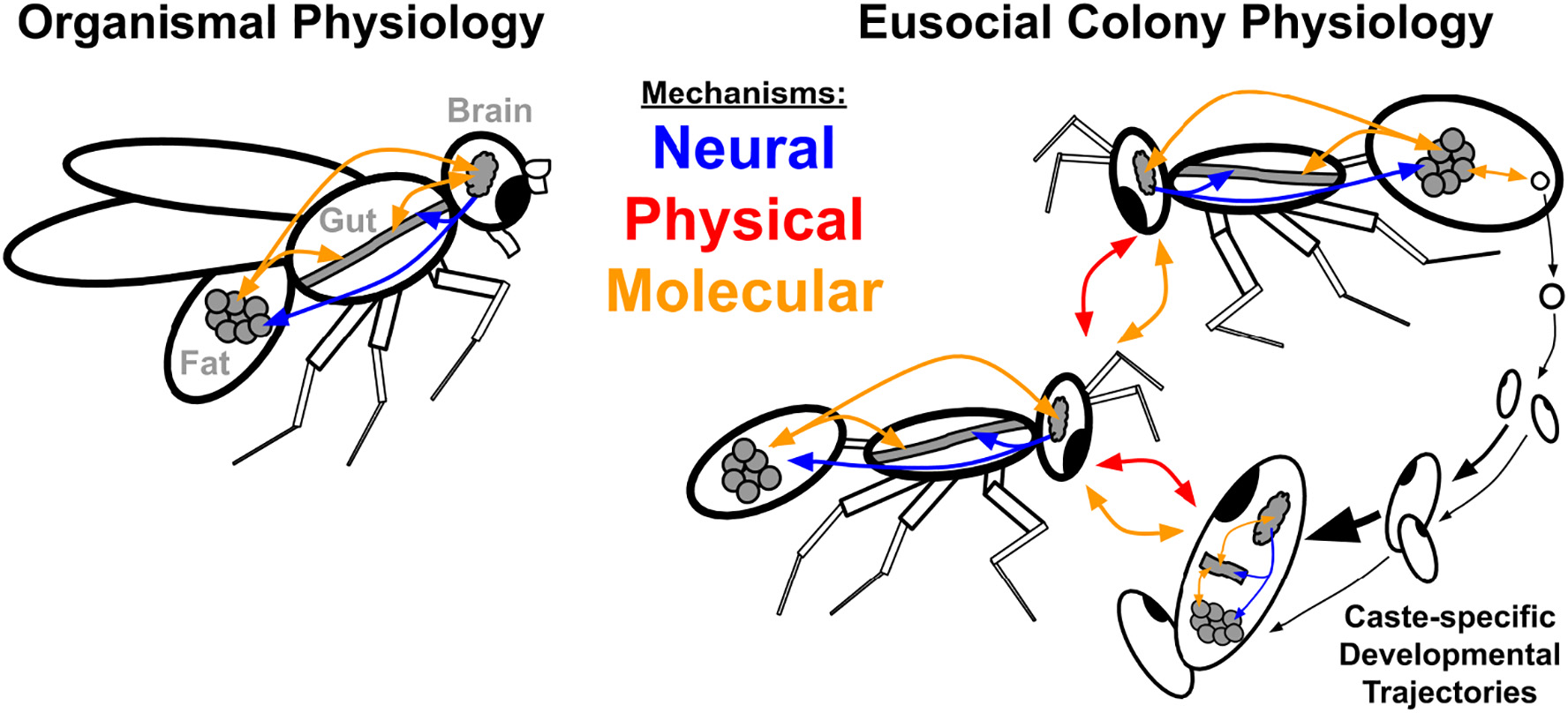
The traditional focus of physiological and functional genomic research is on molecular processes that play out within a single multicellular organism. In the colonial (eusocial) insects such as ants, bees, and termites, molecular and behavioral responses of interacting nestmates are tightly linked, and key physiological processes are regulated at the scale of the colony. Such colony-level physiological processes regulate nestmate physiology in a distributed fashion, through various social communication mechanisms. As a result of physiological decentralization over evolutionary time, organismal mechanisms, for example related to pheromone detection, hormone signaling, and neural signaling pathways, are deployed in novel contexts to influence nestmate and colony traits. Here we explore how functional genomic, physiological, and behavioral studies can benefit from considering the traits of eusocial insects in this light. We highlight functional genomic work exploring how nestmate-level and colony-level traits arise and are influenced by interactions among physiologically-specialized nestmates of various developmental stages. We also consider similarities and differences between nestmate-level (organismal) and colony-level (superorganismal) physiological processes, and make specific hypotheses regarding the physiology of eusocial taxa. Integrating theoretical models of distributed systems with empirical functional genomics approaches will be useful in addressing fundamental questions related to the evolution of eusociality and collective behavior in natural systems.
Overview source: Curated paper metadata.
Artifacts
Tracked documentation and PDFs served directly from this folder.
README AGENTS SKILL Metadata Extracted text Citation metadata
- 2020_DistributedPhysiology.pdf 711,416 bytes · extracted-text source